An environmental-health AI research assistant
for digital platforms.
Six capabilities. One API. A cited evidence engine that connects your users' conditions, biomarkers and environment to verified, biomedical research — at scale, zero PII, non-clinical.
500,000+ curated peer-reviewed papers. Smart retrieval that knows which ones matter. Updated weekly.
We don't return the nearest neighbour. We return the right paper. A five-stage RAG pipeline ranks, filters and gates every result against the submitted condition profile — including medication, sub-types and known triggers — with or without location.
- PubMed corpus across 18 condition categories — 535,677 papers at 100% embedding coverage via BAAI/bge-base-en-v1.5 (768-dim vectors)
- Condition-profile-aware retrieval: medication class, condition subtype and known triggers all shift the ranked results
- Location optional — the same engine works in Mode 3 with biomarkers or longevity signals, no environment required
- RCR-scored and retraction-checked — every paper carries relative citation ratio and retraction status before surfacing
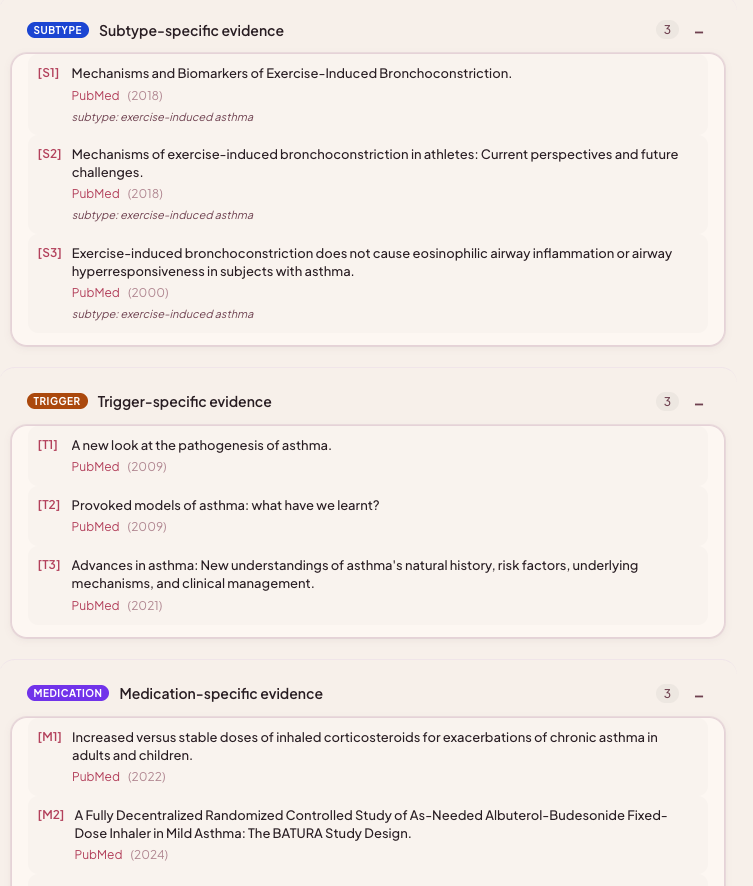
Every insight is traceable to a specific paper. Not a summary — a citation.
Synthesis paragraphs carry inline citation markers [1], [2] that map directly to PubMed papers with PMID, publication year, journal, RCR score and effect size. Your users and clinicians can follow the chain — every time.
- Inline citation markers in every synthesis paragraph — [1], [2] etc. — each resolving to a full PMID and URL
- Effect sizes and matched factors returned per paper — not just titles, but what the evidence actually shows
- Uncertainty notes included by default — the model is explicitly prompted to acknowledge gaps, never overclaim
- Retraction screening on every paper before it surfaces — iCite integration, not an afterthought
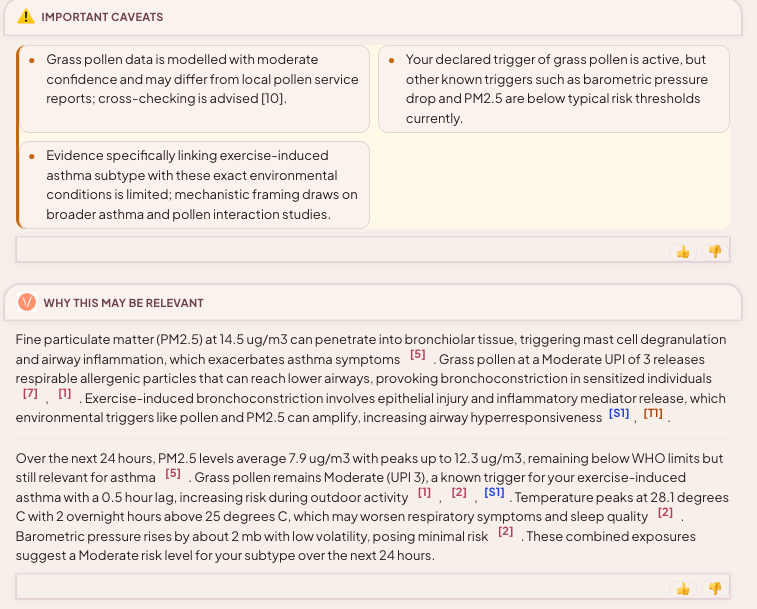
Referenceable in chat and natively composable with AI models.
The API response is structured for downstream AI use — citations, effect sizes and synthesis are all returned as clean JSON. Pass them directly into your LLM context, your chat UI, or your clinical decision flow.
- Conversational AI assistant included — follow-up questions answered using only the retrieved corpus, never confabulated
- Structured JSON output — synthesis, citations, mechanisms, recommendations and uncertainty notes all separately addressable
- Prompt version tracked in every response (v4.1) — output quality changes are auditable across deployments
- Drop-in compatible — the response shape is designed to feed directly into existing LLM orchestration layers
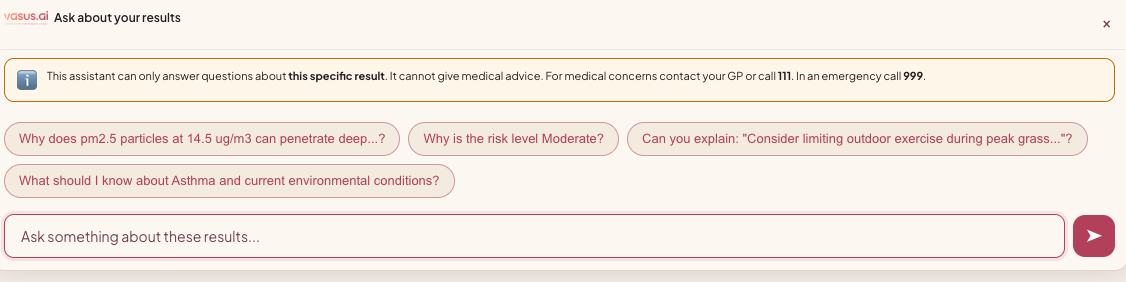
Connected to live environmental data — ours, yours, or none at all.
Three integration modes give partners complete flexibility. Use our real-time feed from Google Air Quality, Weather and Pollen APIs. Send your own sensor readings. Or skip the environment entirely and query on biomarkers alone.
- Mode 1 — We provide the environment: live PM2.5, AQI, barometric pressure, pollen UPI, heat index and dew point per location
- Mode 2 — You provide the environment: send your own sensor or feed data, we return ranked citations and effect sizes against it
- Mode 3 — No environment: condition, biomarker or longevity pattern only — same cited engine returns matched literature
- All three modes use the same endpoint and response schema — switching is a single field change
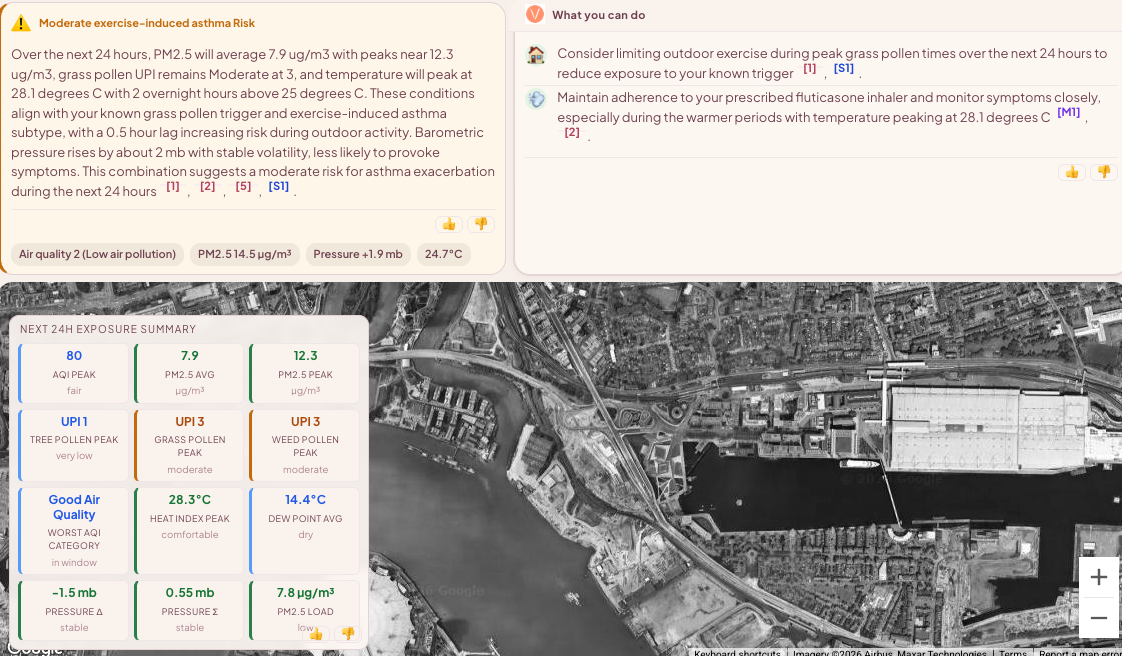
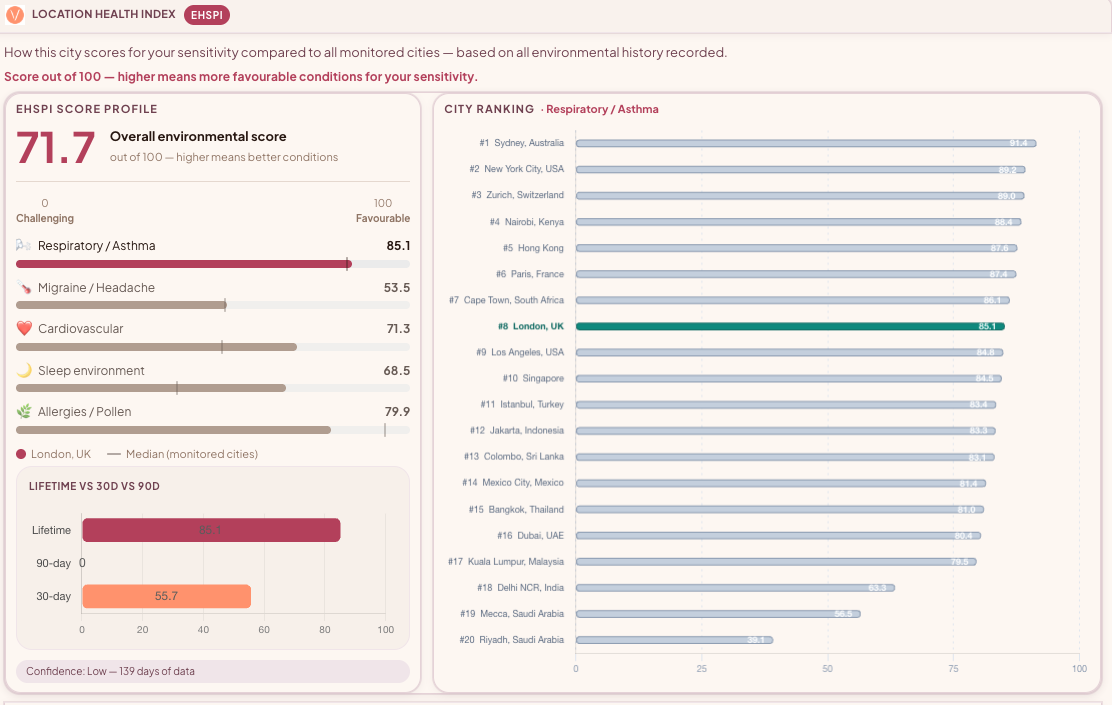
Composite location scores — 20 cities, 5 conditions, nightly.
A composite location score that quantifies relative environmental burden across five chronic condition sensitivities. Updated nightly from accumulated signal history. Scores are relative within the 20-city monitored set — fully cited, patent pending.
- Condition-specific scores for all 20 cities in one call, including composite and confidence label
- 90-day time series per tile for trend analysis and seasonal pattern detection
- Weight vectors published openly — every signal weight is documented, cited, and returned in the API response
- Confidence tiers by history depth — Minimal → Low → Moderate → High as data accumulates over 90 days
Five-stage evidence pipeline. Every call.
Every API request runs through the same deterministic pipeline — no shortcuts, no cached hallucinations. Each stage filters and re-ranks before passing to the next.
LLM decomposes the condition + environment into sub-queries, must-have terms and exclusions. Year-filtered to surface contemporary evidence.
FAISS HNSW index over 535K pgvector embeddings. Top-k candidates by cosine similarity across the condition-relevant corpus slice.
Lexical BM25 re-ranking combined with semantic score. RCR-weighted influence adjustment and iCite retraction screening.
LLM evaluates each candidate paper for condition relevance and environmental signal fit. Rejects topically adjacent but clinically irrelevant papers.
GPT-4.1-mini generates risk level, mechanisms, recommendations and uncertainty notes — grounded only in gated, cited papers.
Built for the healthcare-adjacent enterprise.
No new compliance burden. Zero PII by architecture. Research infrastructure, not a medical device.
Condition flag and location only
No identity, no raw health records, no GDPR Article 9 exposure on our side. No new data-sharing agreements required.
Research infrastructure, not a device
No MHRA/FDA classification path. No DCB0129. Closer to UpToDate than a symptom checker. Zero clinical liability overlay.
Private SQL, locked CORS, stateless
Credentials in Secret Manager. Cloud Run (HTTPS only). CORS locked to partner origins. API keys rotatable and rate-limited.
Zero-PII environmental scoring method
The environmental health scoring method is patent pending. Protects partners from downstream clinical AI regulatory exposure.
Ready to add an AI research assistant to your platform?
Free API access to test against your own use cases. 30-minute founder call. Founding-partner terms.